

Why Low Impact Workouts Don’t Mean Low Impact Results
Maybe you’ve been told that if you’re not jumping, sprinting, or leaving the gym completely exhausted, you’re not working hard enough. Here’s the truth: low impact workouts can deliver serious results without putting the same repetitive impact on your joints.
Low impact doesn’t mean low intensity. And it definitely doesn’t mean easy.
From building strength and improving cardiovascular fitness to supporting weight loss goals, the effectiveness of a workout depends on how you challenge your body, not how much jumping is involved.
If “no pain, no gain” has shaped the way you think about exercise, it’s time to look at low impact differently. Gentler on your joints can still mean stronger, sweatier, and seriously challenging.

What Is a Low Impact Workout?
A low impact workout focuses on movements that minimize repetitive impact on your joints. Typically, at least one foot stays in contact with the ground during standing exercises, although low impact workouts can include a wide variety of movements and training styles.
Think walking, swimming, cycling, yoga, Pilates, barre, and controlled resistance training. These exercises can challenge your muscles and elevate your heart rate without the repeated landing forces associated with activities like running, jumping, or explosive plyometrics.
Here’s the important distinction: low impact describes the amount of impact placed on your body, not the intensity of your workout.
That means a low impact workout can still make your muscles shake, raise your heart rate, and seriously challenge your strength and endurance.
It’s also what makes low impact exercise so adaptable. Beginners can start with accessible variations, while experienced exercisers can increase resistance, range of motion, tempo, or other variables to make the same movements significantly more challenging.
Are Low Impact Workouts Effective?
Absolutely. Low impact workouts can be an effective way to build strength, improve cardiovascular fitness, increase endurance, and support overall fitness.
Your body doesn’t require jumping to get stronger.
Muscles respond to resistance and challenge. Your cardiovascular system responds when the demands of exercise increase. A well-designed low impact workout can provide both while reducing the repeated impact associated with higher-impact movements.
The real question isn’t simply whether a workout is low impact. It’s whether you’re giving your body enough challenge to create progress.
Can You Build Muscle With Low Impact Workouts?
Yes. Low impact workouts can build muscle when they include enough resistance and progressive challenge.
Resistance training is one of the biggest reasons low impact doesn’t have to mean low results. When you perform movements against resistance, your muscles have to work.
That resistance might come from:
- Your own bodyweight
- Dumbbells or other weights
- Resistance bands
- TRX straps
- Isometric holds
- Increased time under tension
- More challenging exercise variations
Progressive overload also applies to low impact strength training. As your body adapts, you can gradually increase resistance, repetitions, range of motion, duration, or difficulty.
Controlled movement can also reduce your reliance on momentum. Try slowing down a squat, holding the bottom of a lunge, or adding resistance to a familiar movement and you’ll quickly discover that your feet don’t have to leave the floor for your muscles to work hard.
Are Low Impact Workouts Good for Weight Loss?
Yes, low impact workouts can support weight loss when they’re part of a consistent routine and an overall lifestyle that supports your goals.
Weight loss isn’t determined by whether your workout includes jumping. Physical activity increases the amount of energy your body uses, while nutrition and overall energy balance also play major roles in weight management.
Low impact cardio activities like cycling, rowing, swimming, and incline walking can increase your heart rate and energy expenditure. Low impact strength training adds another important piece by helping build and maintain muscle.
And don’t underestimate consistency.
A workout that you enjoy, can recover from, and can perform regularly may be more useful over time than an extremely intense routine you struggle to maintain.
The CDC recommends adults get at least 150 minutes of moderate-intensity aerobic activity each week, along with muscle-strengthening activity on at least two days.
Which Low Impact Workouts Burn the Most Calories?
There’s no single low impact workout that will burn the most calories for everyone. How much energy you use depends on factors like your body, workout duration, and intensity.
But plenty of low impact activities can get your heart rate up, including:
- Incline walking
- Cycling
- Rowing
- Swimming
- Low impact circuit training
- Resistance training
- Dance-based fitness
- High-intensity, low-impact workouts
Increasing resistance, pace, workout duration, or reducing recovery periods can make a low impact workout more demanding.
Higher-intensity exercise can also produce excess post-exercise oxygen consumption, commonly called EPOC. During this recovery period, your body’s oxygen consumption remains elevated for a period of time as it returns to its resting state.
The key word here is intensity, not impact.

Low Impact vs. HIIT: What’s the Difference?
Low impact and HIIT aren’t actually opposites.
Low impact describes how much impact a movement places on your body. HIIT describes how a workout is structured.
High-intensity interval training, or HIIT, alternates periods of higher-intensity effort with periods of lower-intensity activity or recovery.
Some HIIT workouts use jumping, burpees, sprints, and other high-impact exercises. But HIIT doesn’t have to include those movements.
That means a workout can be both low impact and high intensity.
Low Impact Workouts
Low impact training may be a good fit if you want to:
- Minimize repetitive impact on your joints
- Build strength through controlled resistance
- Improve cardiovascular fitness
- Modify exercises for your current fitness level
- Increase intensity without relying on jumping
- Create a routine that feels sustainable for your body
Traditional HIIT Workouts
HIIT may appeal to people who enjoy:
- Short bursts of challenging cardiovascular work
- Interval-style training
- Alternating work and recovery periods
- Fast-paced workouts
- Increasing cardiovascular intensity in a shorter workout
Traditional HIIT classes may incorporate higher-impact movements, but impact isn’t a requirement for HIIT.
So which is better?
Neither is automatically better. The best choice depends on your fitness goals, preferences, experience level, and how your body responds to different types of exercise. And you don’t necessarily have to choose between the two.
Can You Do a High-Intensity, Low-Impact Workout?
Absolutely. This is where the difference between impact and intensity really matters.
A high-intensity, low-impact workout can seriously challenge your body without relying on repeated jumping or pounding.
Intensity can be increased by manipulating variables such as:
- Resistance
- Time under tension
- Rest periods
- Range of motion
- Tempo
- Exercise complexity
- Longer holds
- Cardiovascular intervals
For example, holding a challenging position while your muscles are already fatigued can feel incredibly intense without your feet ever leaving the ground.
That’s one reason low impact workouts can work across so many fitness levels. The same basic movement can often be modified or challenged depending on what your body needs that day.

Benefits of Low Impact Workouts
Low impact training isn’t only an alternative for people who can’t perform high-impact exercise. It can be an intentional part of a balanced, effective fitness routine.
Less Repetitive Impact on Your Joints
Low impact exercise minimizes repeated landing forces, giving you a way to challenge your body without the constant pounding associated with activities like running and jumping.
That doesn’t mean high-impact exercise is automatically bad for your joints. It simply means low impact training gives you another way to build fitness when you want less repetitive impact.
Builds Strength and Muscular Endurance
Your muscles respond to resistance, regardless of whether the movement is high or low impact.
Squats, lunges, rows, presses, planks, and other controlled resistance exercises can all help build strength without requiring jumping.
Add resistance, slow down the movement, increase time under tension, or progress to a more challenging variation and a seemingly simple exercise can become much harder.
Supports Cardiovascular Fitness
Low impact doesn’t mean your heart rate has to stay low.
Brisk walking, cycling, swimming, rowing, dance-based exercise, and low impact cardio intervals can all challenge your cardiovascular system.
The intensity of the activity matters more than whether your feet leave the ground.
Makes Consistency More Accessible
The most effective workout routine is one you can actually continue doing.
For some people, reducing high-impact movement can make exercise feel more manageable and help them create a more consistent routine.
That can be especially valuable for beginners, people returning to exercise, or anyone who simply prefers a workout that challenges them without relying on repetitive jumping.
Adapts to Different Fitness Levels
Low impact exercise isn’t reserved for beginners.
The same squat can look very different depending on resistance, tempo, depth, duration, and exercise variation. That makes low impact training easy to scale as your strength and fitness improve.
How to Build an Effective Low Impact Exercise Routine
An effective fitness routine doesn’t need to be complicated. A balanced low impact approach can incorporate strength, cardio, mobility, and recovery.
Make Resistance Training Part of the Foundation
Resistance training helps build and maintain strength while supporting functional movement.
You can use:
- Bodyweight
- Resistance bands
- Dumbbells
- Weight machines
- TRX straps
- Other resistance equipment
Focus on movements that engage multiple muscle groups, such as squats, lunges, rows, presses, and other functional movement patterns.
Add Low Impact Cardio
Cardiovascular exercise doesn’t have to involve running or jumping.
Options include:
- Incline walking or hiking
- Swimming or water aerobics
- Cycling or stationary bike intervals
- Rowing
- Dance fitness
- Low impact cardio circuits
- True40 classes
Choose activities you enjoy and can realistically make part of your routine.
Don’t Forget Mobility and Recovery
More isn’t always better.
Mobility work, stretching, recovery, and rest all have a place in a balanced fitness routine. Giving your body time to recover can help you return to your next workout ready to move well and challenge yourself again.
Cross training can also provide variety while challenging your body in different ways.
Making Low Impact Work for Your Fitness Level
One of the biggest advantages of low impact exercise is that it can meet you where you are.
If You’re a Beginner
Starting a new exercise routine can feel overwhelming, but you don’t have to begin at maximum intensity.
Start with basic movements and gradually increase duration, resistance, or complexity as your fitness improves.
You can adjust:
- Range of motion
- Resistance
- Workout duration
- Number of repetitions
- Pace
- Rest periods
And don’t underestimate the role of the people around you. Finding a supportive fitness environment can make starting and sticking with a routine feel a lot less intimidating. Learn more about the role of community in your fitness journey.
If You’re Ready for More Intensity
Think low impact means easy?
Try slowing down your movements, increasing resistance, holding a challenging position longer, or reducing your recovery time.
You can increase the challenge with:
- Heavier resistance
- Longer holds
- Increased time under tension
- Shorter rest periods
- More challenging variations
- Greater range of motion when appropriate
The goal is to continue challenging your body as your fitness improves.

Why True40 Combines Low Impact With High Intensity
At True40, low impact has never meant taking it easy.
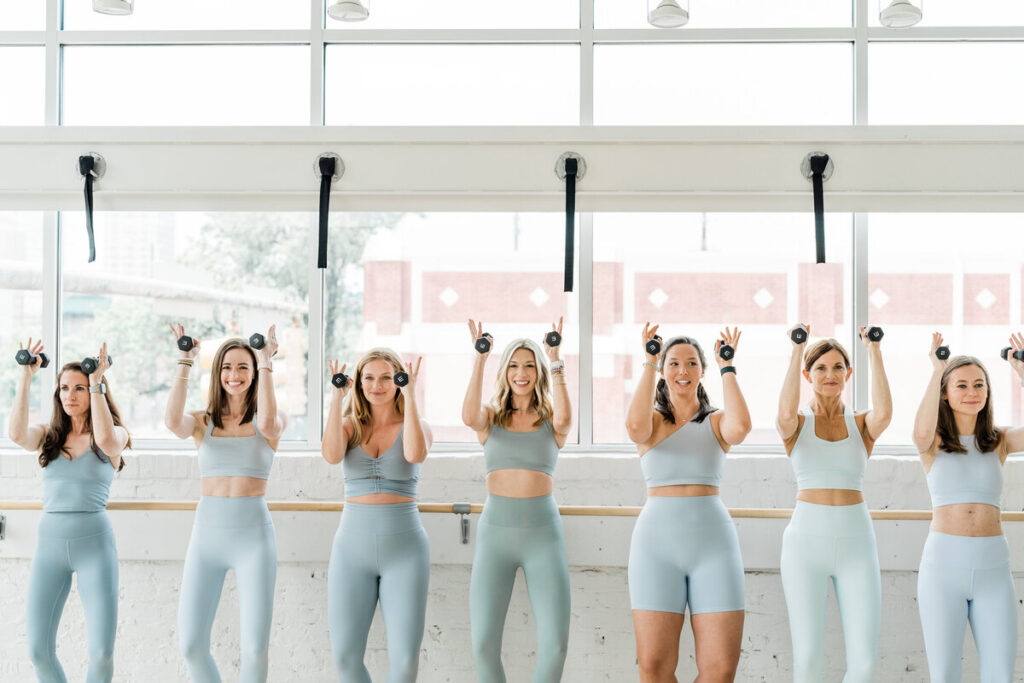
The True40 method is a fusion of high-intensity, low-impact strength training inspired by barre, functional strength training, Pilates, and yoga. True40 classes combine strength, cardio, and mobility while offering modifications and challenges that allow clients to adjust the workout to their bodies and fitness levels. (True40 Studio)
A typical class may incorporate free weights, TRX straps, bodyweight exercises, barre-inspired movements, Pilates-based core work, and yoga-inspired recovery.
And because classes include both modifications and optional challenges, you can adjust your workout based on what your body needs that day.
Want to see what that looks like? Learn more about the True40 Fusion Class, or find a True40 class that works for you.
Low Impact Doesn’t Mean Low Results
The fitness industry has spent years making us believe an effective workout has to involve jumping, pounding, or leaving class completely wiped out.
It doesn’t.
Low impact describes how movement affects your body, not how hard you’re working or how effective your workout can be.
Whether your goal is building strength, improving cardiovascular fitness, supporting weight management, or simply creating a routine you can maintain, low impact exercise can provide plenty of challenge without requiring constant high-impact movement.
The best workout isn’t automatically the one with the most jumping, the most sweat, or the hardest movements. It’s one that challenges you, supports your goals, and gives you a reason to keep coming back.
Ready to discover what high-intensity, low-impact training can do for you?
Grab your socks and we’ll see you in the studio!
Want more from True40 Fitness in your Google results?
Add us as a preferred source to continue getting more updates.